

The World After New START
Introduction: What is New START?
The New START treaty, formally known as Measures for the Further Reduction and Limitation of Strategic Offensive Arms, has expired as of 5 February 2026, leaving the world without any legally binding limits on both U.S and Russian strategic nuclear arsenals for the first time since the 1972 Strategic Arms Limitation Talks (SALT). The expiration of the New START treaty marks the erosion of the last pillar for U.S.-Russia nuclear arms control, increasing systemic uncertainty, weakening and threatening global non-proliferation norms, and further reshaping strategic calculations across both major and minor powers. The treaty was first announced on March 26, 2010, and then formally signed on April 8, 2010, in Prague, Czech Republic, under U.S. President Barack and Russian President Dmitry Medvedev. The treaty itself later entered into force on February 5, 2011, superseding the ongoing nuclear arms treaty The Strategic Offensive Reductions Treaty (SORT) that was initially supposed to end on December 31, 2012.
The duration of the treaty itself was set to last over 10 years, ending in 2021. Shortly after President Joe Biden was sworn into office, he extended the treaty, pushing the final expiration date of the treaty to February 5, 2026
The New START imposed three key limits:
- No more than 1.550 deployed strategic warheads for both sides
- No more than 700 deployed ICBMS, SLBMs, and heavy bombers for both sides
- 800 deployed and non-deployed launchers
Yet the treaty’s true significance lies beyond these numerical caps. Its most stabilising feature was its verification regime, which included on-site inspections, annual data exchanges, and detailed notification requirements. These mechanisms are what reduced uncertainty, limited any worst-case scenario military planning, and provided predictability between the world’s two largest nuclear powers.
The Move Away from “Declaratory” Control (SORT)
To understand the structural importance of New START, it must be situated within the broader trajectory of post-Cold War arms control. The treaty did not emerge out of nowhere or in isolation, it was negotiated to address any shortcomings in its predecessor, the Strategic Offensive Reductions Treaty (SORT)
SORT, also known as the Moscow Treaty, was the same nuclear arms control treaty, the predecessor to the New START. The treaty itself was signed by President George W Bush and President Vladimir Putin on May 20, 2002. The treaty committed both states to reduce deployed strategic nuclear warheads to between 1.700 and 2.200 by December 31, 2012.
However, SORT reflected a markedly different principle of arms control compared to earlier agreements. It contained only a few pages of text, imposed no independent verification regime, and relied heavily on mechanisms that are inherited from earlier frameworks such as Strategic Arms Limitation Talks and START I, Crucially;
- No detailed verification regime (the treaty itself is still heavily reliant on SALT I mechanisms),
- Warheads could be removed from deployment but not destroyed.
Why Replace SORT With New START?
Why did they replace SORT in the first place? Why didn’t they extend the already existing nuclear arms control treaty? From the US perspective, the Obama administration sought to strengthen transparency mechanisms, a legally binding verification, and a restoration of arms control credibility. This made the New START more institutionalised and more rigorous compared to its predecessor, SORT. Secondly, U.S.–Russia relations were becoming more strained, increasing the value of legally binding inspection frameworks
New START, therefore, reintroduced on-site inspections, data exchanges, and notification requirements that had lapsed after START I’s expiration. Unlike SORT’s declaratory reductions, New START embedded detailed and numerical limits within the framework and legally bound both nations.
What Changes Now That It Has Expired?
If the transition from SORT to New START was a move towards an “Institutional Rigor”, the 2026 expiration is a violent leap backward, to say the least. For the first time since the Nixon administration in 1972, the world’s two nuclear superpowers are operating in a legal vacuum, effectively we have “un-learned” the lessons of the Cold War, trading verified certainty for a “Wild West” of strategic ambiguity and as of now the U.S. and Russia now hold approximately 85–90% of the world’s nuclear warheads (SIPRI, 2024).
Figure 1 – Global Nuclear Inventories, January 2024
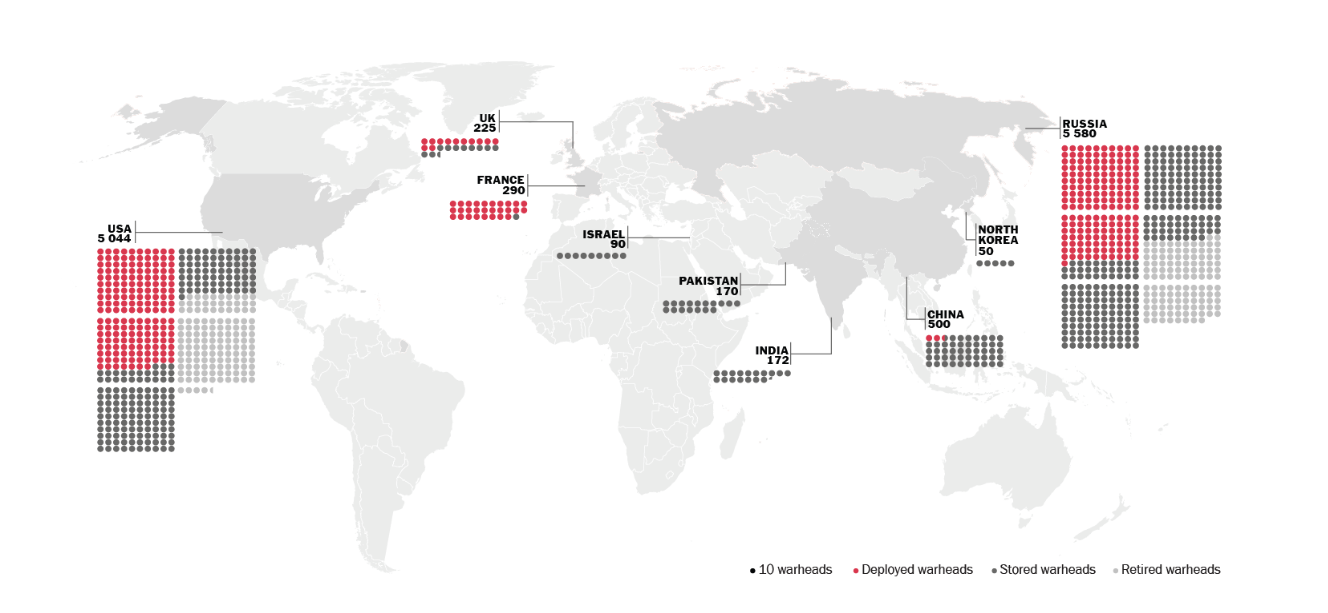
Note. This image illustrates the distribution of deployed, stored, and retired warheads around the nine nuclear-armed states as of early 2024. The data of the stored and retired counts are estimates based on the available data. From World Nuclear Forces, by H.M. Kristensen et al., 2024, SIPRI (https://www.sipri.org/yearbook/2024/07).
Under New START, these were “caged” by the 1.550 deployed limit. Without the legally binding cap, both nations now possess significant “upload capacity.” For example, the U.S. could technically just double its deployed warhead count by simply filling the empty slots that are present in Minuteman III and Trident II missiles that were kept vacant to abide by the treaty that has now expired (CSIS, 2026). And as noted before, the lack of a cap means there is no legal barrier that protects us from a potential “breakout.” If one side perceives the other is surging, the “Realist” response is to surge in kind.
Strategic Blindness: The Death of the “Verification Machine”
The most immediate and dangerous change does not lie within the number of the bombs, but the loss of sight or transparency from “Data to Guesswork.” Between 2011 and 2023, the U.S. and the Russian have exchanged over 25.000 notifications regarding the movement and status of their nuclear forces (U.S. State Department, 2023). And as of two weeks ago, that ticker has stopped.
We have lost both “Type One’ and “Type Two” inspections that have allowed experts to actually stand in a silo to count warheads. With the death of the “Verification Machine,” both sides now must rely solely on their National Technical Means (satellites and SIGINT). While advanced, satellites are unable to see through the roof of a bunker, making them nearly unreliable to use to count how many warheads are there.
The “Worst-Case” Military Planning
In the absence of transparency, military planners don’t “hope for the best,” they assume the worst, not because they are pessimistic but because they can’t afford the risk. If U.S. intelligence sees a Russian missile base being modernised but is unable to inspect it, they must assume Russia is maximising its warhead count.
This creates an “action-reaction” cycle. The U.S. modernises to “hedge” against Russia, and if China sees the U.S. modernising and accelerates its own 1.000-warhead goal, then China would react to both. Stability is replaced by a permanent state of high-alert anxiety.
Implications for the International System and the Global South
Realism interprets the treaty’s death as an inevitable result of the shift from a bipolar to a multipolar world. U.S. planners argue that by continuing the New START treaty, which is a bilateral treaty, while China rapidly modernises its arsenal, projected to hit 1.000 warheads by 2030, is strategically untenable for the U.S. Without any transparency provided by on-site inspections, both sides would eventually have to assume a “worst-case” scenario, leading to defensive hedging and a potential arms race. It also warns that the loss of a global “guardrail” may provoke middle-power countries that initially stood inside the U.S. “nuclear umbrella” to reconsider their own nuclear status, which would likely happen due to internal pressure to ensure their survival in an unconstrained environment.
Liberalism views the end of said treaty as the catastrophic erosion of the international “rule-based” order. The primary danger lies within the collapse of the verification regime. For decades, mandatory data exchanges and on-site served as “information stabilisers” aimed to reduce the risk of accidental war. Without the presence of the treaty, there is no legal “rulebook” governing 90% of the world’s nuclear warheads. The collapse was further emphasised by the shift toward informal military-to-military “dialogue” rather than binding law, which signals a regression in international cooperation.
From the viewpoint of the Global South, the treaty’s collapse and end is seen not just as an international security failure but as a violation of the Nuclear Non-Proliferation Treaty (NPT) Article VI “grand bargain”. Non-nuclear states in the Global South forswore and forbade nuclear weapons in exchange for states that do possess nuclear weapons pursuing disarmament. The death of the New START effectively ends progress toward that said goal, further fuelling a legitimacy crisis in the NPT.
Russia’s Willingness to Extend vs U.S. Strategic Recalibration
Moscow’s official stance, articulated by President Putin in late 2025 and reiterated by the Russian Foreign Ministry in February 2025, was a proposal to maintain the central quantitative limits by extending the treaty by one additional year, and Moscow framed this as a constructive step to avoid an arms race. However, this offer has its own conditions, Russia requires the U.S. to refrain from taking any steps that can undermine the existing balance of deterrence, aiming towards U.S. advancements in missile defense.
The White House under the Trump administration, early in 2026, viewed that the New START was an outdated and “flawed” relic of a bipolar world that ignored the trilateral reality. The U.S. argued that any new treaty must include China, which is projected to have 1.000 warheads by 2030. The U.S. also sought modernisation over maintenance rather than a simple extension of the “old and flawed” treaty, the U.S. prioritised its $946 billion modernisation program and the development of the Golden Dome missile defense system, viewing the treaty constraints as an obstacle to necessary strategic flexibility (CBO, 2025; CRS, 2026).
Experts and Policymaker Concerns
The primary concern lies within the total loss of the verification regime. Under New START, the U.S. and Russia conducted on-site inspections and exchanged data twice annually. Without these inspections, the U.S. must rely on “National Technical Means” (e.g, satellite imaging). This could lead to a strategic hedging where, if the U.S. can’t observe how many warheads are on a Russian RS-28 Sarmat missile, planners would assume it is fully loaded.
Barack Obama, the 44th President of the U.S., warned that the lapse could wipe out decades of diplomatic effort to maintain international stability, signaling a return to the volatile Cold War environment of the early 1960s. Another former president, Dmitry Medvedev, the 3rd President of the Russian Federation, noted that the expiration of the treaty should alarm everyone, further stating that the “trust has been exhausted”. On February 5, 2026, high-ranking former officials from the U.S., Europe, and Russia released a joint statement through the Arms Control Association, warning that we have entered an era of unconstrainedness where both stability and predictability have vanished.
Navigating the “Third Nuclear Era”
The expiration of New START on February 5, 2026, signifies a profound regression in the international security architecture. By moving from a regime of “Institutional Rigor,” it has regressed back to a legal vacuum, the U.S. and Russia have both traded for a “Wild West” strategic ambiguity over a verified certainty. This transition marks the definitive start of the “Third Nuclear Era,” where the binary stability of the Cold War is replaced by a volatile, trilateral competition involving a rapidly modernising China.
For the Structural Realist view, the lapse is a pragmatic response to the shift of power, yet it comes with its inherent risk of “Worst-Case” military planning and a three-way arms race. For the Institutional Liberal, it represents the catastrophic erosion of a world with a rule-based order, replacing binding law with informal military-to-military dialogues that lack any transparency that is needed to prevent any accidental escalation due to miscalculation or paranoia. Most critically, for the Global South, the death of the New START is a violation of the NPT’s “Grand Bargain.” It signals that the world’s most powerful states have prioritised trillion-dollar modernisation programs over their legal and moral obligations toward disarmament of nuclear weapons and global development.
Ultimately, the world after New START is one of “high-alert anxiety.” Without any of the “guardrails” that are provided by on-site inspections and numerical caps, international stability now rests not on the strength of treaties or institutions, but on the fragile technical restraint of individual leaders. The task for the international community is no longer just to extend old treaties, but to build a new, better, multilateral framework that can contain the complexities of a tri-polar nuclear age.
Bibliography
Al Jazeera. (2026, February 5). Russia says will act responsibly despite New START nuclear treaty expiry. Al Jazeera. https://www.aljazeera.com/news/2026/2/5/russia-says-will-act-responsibly-despite-new-start-nuclear-treaty-expiry
Arms Control Association. (2026, February 5). Joint Statement from High-Ranking Former Officials and Nuclear Experts Across the Globe on Expiration of New START. https://www.armscontrol.org/pressroom/2026-02/joint-statement-high-ranking-former-officials-and-nuclear-experts-across-globe
Associated Press. (2026, February 4). Fears loom for a new arms race as the last nuclear pact between the US and Russia expires. AP News. https://apnews.com/article/russia-us-nuclear-weapons-treaty-putin-trump-5b1af24b0b3e65a8acb6ca7153018beb
Congressional Budget Office. (2025, April 24). Projected costs of U.S. nuclear forces, 2025 to 2034. https://www.cbo.gov/publication/61362
Congressional Research Service. (2025, September 29). Defense primer: The Golden Dome for America (Report No. IF13115). https://www.congress.gov/crs-product/IF13115
Congressional Research Service (CRS). (2026, February 6). U.S.-Russian Nuclear Arms Control: Overview and Potential Considerations for Congress. https://www.everycrsreport.com/reports/IN12640.html
IISS. (2026, February 5). Cost constraints on the US–Russia strategic nuclear balance after New START. International Institute for Strategic Studies. https://www.iiss.org/online-analysis/online-analysis/2026/02/cost-constraints-on-the-us-russia-strategic-nuclear-balance-after-new-start/
International Campaign to Abolish Nuclear Weapons. (2026, February 4). New START expiration: what it means and what’s next. https://www.icanw.org/new_start_expiration
Kristensen, H. M., Korda, M., Johns, E., & Knight, M. (2024). World nuclear forces. In SIPRI Yearbook 2024: Armaments, Disarmament and International Security. Oxford University Press. https://www.sipri.org/yearbook/2024/07
Kristensen, H. M., Korda, M., Johns, E., & Knight, M. (2025, October 31). Status of world nuclear forces. Federation of American Scientists. https://fas.org/initiative/status-world-nuclear-forces/
Lendon, B., & Hansler, J. (2026, February 4). The last major nuclear arms treaty between the US and Russia just expired. Here’s what happens now. CNN. https://edition.cnn.com/2026/02/04/world/new-start-treaty-expiration-nuclear-weapons-intl
Ministry of Foreign Affairs of Russia (MID). (2026, February 4). Statement of the Ministry of Foreign Affairs of Russia Concerning the Expiration of the Russia-US New START Treaty. https://mid.ru/en/foreign_policy/news/2076815/
Reuters. (2026, February 4). Trump rejects Putin’s offer of a one-year extension of New START deployment limits. Reuters. https://www.reuters.com/world/china/new-nuclear-age-beckons-clock-ticks-down-last-russia-us-arms-deal-2026-02-04/
Stimson Center. (2026, January 5). Top Ten Global Risks for 2026. https://www.stimson.org/2026/top-ten-global-risks-for-2026/
Stockholm International Peace Research Institute. (2026, February 4). After New START expires, Europe needs to step up on arms control. SIPRI. https://www.sipri.org/commentary/essay/2026/after-new-start-expires-europe-needs-step-arms-control
The Guardian. (2026, February 3). Expiry of nuclear weapons pact between US and Russia risks new arms race. https://www.theguardian.com/world/2026/feb/03/expiry-nuclear-weapons-pact-us-russia-arms-race
United Nations. (1968, July 1). Treaty on the Non-Proliferation of Nuclear Weapons (NPT). https://www.un.org/en/conf/npt/2005/npttreaty.html
United Nations. (2026, February 5). UN chief warns of ‘grave moment’ as final US-Russia nuclear arms treaty expires. UN News. https://news.un.org/en/story/2026/02/1166892
U.S. Department of State. (2023). New START Treaty. Bureau of Arms Control, Verification, and Compliance. https://www.state.gov/new-start-treaty
U.S. European Command (EUCOM). (2026, February 5). US and Russia agree to resume high-level military-to-military dialogue. https://www.eucom.mil/pressrelease/44261/the-us-and-russian-federation-agreed-to-reestablish-high-level-military-to-military-dialog