


What Is a Digital Carbon Footprint?
Every day, we scroll through social media, stream our favorite videos, store photos in the cloud, and use artificial intelligence (AI) to make our lives easier. These activities may seem harmless because they do not produce visible smoke or waste. However, have you ever wondered what happens behind the screens we use every day? Every digital activity relies on electronic devices, networks, and data centers that consume energy and contribute to greenhouse gas emissions. This hidden environmental impact is known as the digital carbon footprint.
A digital carbon footprint refers to the greenhouse gas emissions generated by the production and use of digital technologies and services. These emissions come from various sources, including the manufacturing of electronic devices, the electricity consumed by data centers, and the networks that keep us connected to the internet. In other words, our online activities depend on physical infrastructure that requires energy and natural resources, contributing to climate change.
As digital technology becomes an increasingly important part of our daily lives, understanding its environmental impact is more important than ever. Recognizing the connection between our digital habits and energy consumption is an important first step toward using technology more responsibly.
How Big Is the Problem?
We often think digital activities do not harm the environment because their direct impact is not immediately visible. However, using digital technology also contributes to greenhouse gas emissions. According to a peer-reviewed study published in Patterns, the Information and Communication Technology (ICT) sector accounts for an estimated 1.8% to 2.8% of global greenhouse gas emissions. The researchers also suggest that this figure could rise to 2.1% to 3.9% when gaps in supply-chain data are taken into account.
These emissions do not come only from the electricity we use when charging our phones or operating our laptops. They also result from manufacturing digital devices, running data centers, and maintaining the networks that allow us to access the internet. This means that even everyday activities, such as scrolling through social media, watching videos, and storing photos online, depend on technology that requires energy and resources.
While one person’s digital activities may seem insignificant, their combined impact becomes much greater when billions of people perform similar activities every day. As our lives become increasingly connected to digital technology, its environmental impact is something we should not overlook. Understanding the scale of this problem can help us become more aware of our digital habits and the environmental consequences behind them.
Why the Footprint Keeps Growing
The growing use of artificial intelligence (AI) and other online services is contributing to an increase in electricity demand at data centers. Although digital activities may not seem harmful, every time we use AI-powered applications, stream online videos, or store data in the cloud, we rely on data centers. These facilities operate servers and cooling systems that require substantial amounts of electricity.
According to the International Energy Agency (IEA), global electricity consumption by data centers is expected to more than double by 2030 compared with 2024. This projection reflects the growing demand for digital services, including AI, cloud computing, and online platforms. As these technologies continue to develop and become more widely used, data centers will need more electricity to support their operations.
This growing demand is closely related to the digital carbon footprint because the electricity consumed by data centers can generate carbon emissions, particularly when it comes from fossil fuels. Therefore, the expansion of AI and other digital services raises an important question: how can technology continue to develop without placing excessive pressure on the environment? Improving energy efficiency and increasing the use of cleaner energy sources are important parts of addressing this challenge.
What Really Determines the Footprint?
If digital activities have a carbon footprint, where does it actually come from? A study published by France’s telecommunications regulator, ARCEP, found that digital services accounted for 2.5% of France’s carbon footprint, equivalent to 16.9 million tonnes of CO₂ equivalent out of a total of 663 million tonnes. The study also estimated that the average annual climate impact of digital technology use per person was comparable to driving a car for 2,259 kilometers. These figures describe the situation in France and should not be interpreted as global averages.
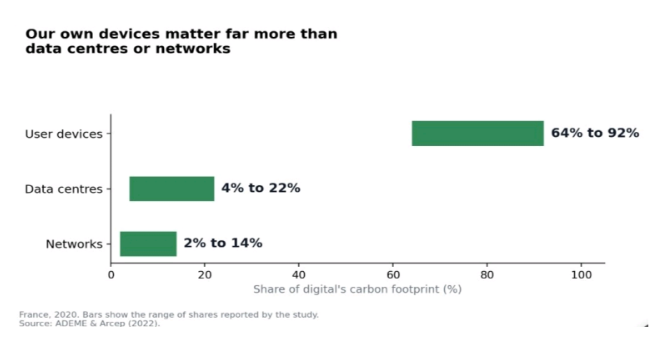
According to the study, most of the digital carbon footprint comes from the devices people use rather than from internet infrastructure alone. User devices contribute between 64% and 92% of the total footprint, while data centers account for 4% to 22% and networks contribute 2% to 14%. These figures show that the production and use of phones, laptops, and other electronic devices play a major role in the environmental impact of digital technology.
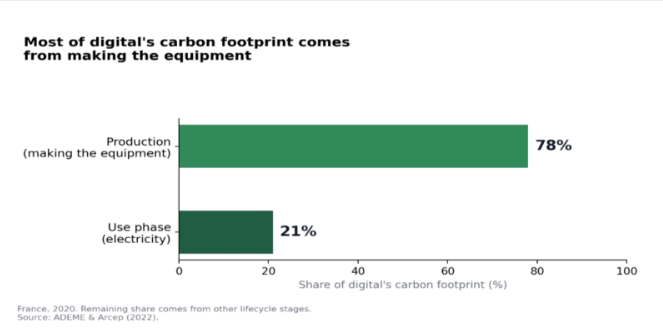
The study also highlights that much of this environmental impact occurs before a device is even switched on. Manufacturing accounts for 78% of the footprint, while the use phase accounts for 21%. Producing electronic devices requires significant amounts of energy, often generated from fossil fuels, as well as raw materials, including rare earth elements. During the use phase, the main environmental impact comes from electricity consumption.
These findings highlight the importance of extending the lifespan of electronic devices. Repairing damaged equipment, reusing devices, and choosing refurbished products can help reduce the environmental impact associated with manufacturing new ones. In other words, one of the most effective ways to reduce our digital carbon footprint is to avoid replacing devices before it is necessary.
Efficiency vs. Growth
AI and other digital technologies are becoming more efficient, allowing them to perform certain tasks while using less energy. However, improvements in efficiency do not necessarily mean that total electricity consumption will decrease. As more people use AI and digital services, overall demand continues to grow. Data centers consequently require more electricity to support the increasing number of users and digital activities.
This highlights the difference between improving energy efficiency and reducing total environmental impact. Even when individual technologies become more efficient, growing demand can offset some of the energy savings. Therefore, technological improvements alone may not be enough to reduce carbon emissions. Companies also need to improve data-center efficiency and increase their use of cleaner energy sources.
As users, we can also contribute by taking better care of our electronic devices, using them for longer, repairing them when possible, and avoiding unnecessary upgrades. These actions can help reduce the demand for newly manufactured devices and the resources needed to produce them.
Digital technology makes our lives easier and creates new opportunities, but it also comes with environmental costs. Understanding the digital carbon footprint allows us to recognize that our online activities have a physical impact. By balancing technological development with responsible consumption, longer device lifespans, and greater energy efficiency, we can help reduce the environmental impact of our digital lives.
References
- ADEME & Arcep. (2022, January 19). The digital environmental footprint in France: ADEME and Arcep submit their first report to the Government [Press release]. Arcep. https://en.arcep.fr/fileadmin/user_upload/04-22-english-version.pdf
- Crown Publications. (2025, April 24). Energy demand for AI – is it sustainable? Electricity + Control. https://www.crown.co.za/latest-news/electricity-control-latest-news/32431-energy-demand-for-ai-is-it-sustainable
- Exarheas, A. (2026, April 20). Data center electricity use surges. Rigzone. https://www.rigzone.com/news/data_center_electricity_use_surges-20-apr-2026-183486-article/
- Freitag, C., Berners-Lee, M., Widdicks, K., Knowles, B., Blair, G. S., & Friday, A. (2021). The real climate and transformative impact of ICT: A critique of estimates, trends, and regulations. Patterns, 2(9), 100340. https://doi.org/10.1016/j.patter.2021.100340
- Investment Monitor. (2026, April 21). IEA warns AI could double data centre power use by 2030. https://www.investmentmonitor.ai/news/iea-warns-ai-could-double-data-centre-power-use-by-2030/