






INNOVATION AND TRAGEDY: WORLD TRADE CENTER, THE 9/11 TRAGEDY
Introduction

Have you ever imagined a magnificent skyscraper collapsing in just 15 seconds? Yes, the debris even looked like crumbs of a biscuit. This happened on the morning of September 11, 2001, when the world witnessed one of the most shocking tragedies in modern history. Two hijacked commercial airplanes crashed into the Twin Towers of the World Trade Center (WTC) in New York, United States. The collisions caused massive explosions and intense fires due to the airplane fuel.
Behind this tragic event, there are many fascinating facts from a civil engineering perspective, ranging from the highly innovative structural design, the building’s ability to withstand the impact, to the mechanism of the collapse that occurred within seconds. How was the building able to stand for about an hour after the incident? Let us discuss.
Innovation
The WTC twin towers used the “Perimeter Tube System” concept. Unlike other tall buildings that use many columns within their spaces, engineer Leslie Robertson designed the entire load-bearing system to the exterior walls. This innovation was considered ingenious because it maximized the interior floor space without partitions, allowing the building to have a lot of open space. There are 236 exterior steel columns installed very close together, spaced approximately 1 meter apart.
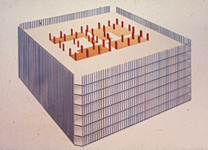
Conceptually, this building functions like a giant steel tube. The building’s outer skin bears most of the wind forces, while the core carries the main load. According to NIST (National Institute of Standards and Technology), this structural system is strong enough for the building to withstand the initial impact of an aircraft and the subsequent redistribution of loads after the collision. When the plane struck the tower, the collision generated enormous energy. This caused many perimeter columns and some core columns to fail immediately. However, the building did not collapse immediately because redundancy is a crucial aspect in structural design.
Collapse
The real problem with the WTC structure was the massive fire that occurred inside the building. After the plane struck the tower, the aircraft fuel ignited an intense fire that then spread due to the large amount of flammable materials inside the offices. The fire temperature was estimated to reach around 800 – 1000°C. At such high temperatures, steel does not actually melt immediately, but its strength can decrease drastically by about 50–60%. Steel also becomes softer and begins to deform.
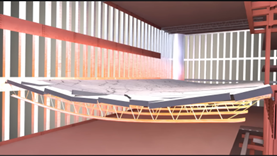
When this truss is exposed to heat for an extended period, the element begins to expand downward. This expansion then pulls the perimeter columns inward, creating a domino effect on the collapse. Once several floors fail simultaneously, a phenomenon known in structural engineering as Progressive Collapse occurs. Imagine stacking vertical dominoes to a height of 110 floors. When the top portion begins to fall, its kinetic energy is far greater than the capacity of the structure below. As a result, the collapse becomes chain-like and exceedingly rapid. That is why the entire building collapsed in less than 15 seconds.
Conclusion
A big lesson for the world of civil engineering from the WTC tragedy changed many skyscraper design standards worldwide with stronger structural redundancy systems. For civil engineering students, the WTC tragedy is a real-life lesson on how structures work and how failures can happen. After all, structural engineering is not just about building tall buildings, but also about protecting the people inside them.
Reference
NIST (National Institute of Standards and Technology).
Final Report on the Collapse of the World Trade Center Towers (2005).
FEMA (Federal Emergency Management Agency).
World Trade Center Building Performance Study (2002).
Robertson, L. E.
Reflections on the World Trade Center. Journal of Structural Engineering.
Bazant, Z. P., & Zhou, Y.
(2002). Why Did the World Trade Center Collapse?
Journal of Engineering Mechanics, ASCE.
McAllister, T., et al.
(2005). Structural Fire Response and Collapse Analysis of the World Trade Center Towers. NIST.
Sabin Civil Engineering, (2024, Juli 16). The Collapse of WTC Solving All the Mysteries. https://youtu.be/m-Haf79ygQY?si=FQNj6d0A5nslrhub